
MORE-THAN-HUMAN: AN INTERVIEW WITH LISA KELLY
Posted on by modronmagazinein #MoreThanHuman, Interviews
Interview by Glyn Edwards
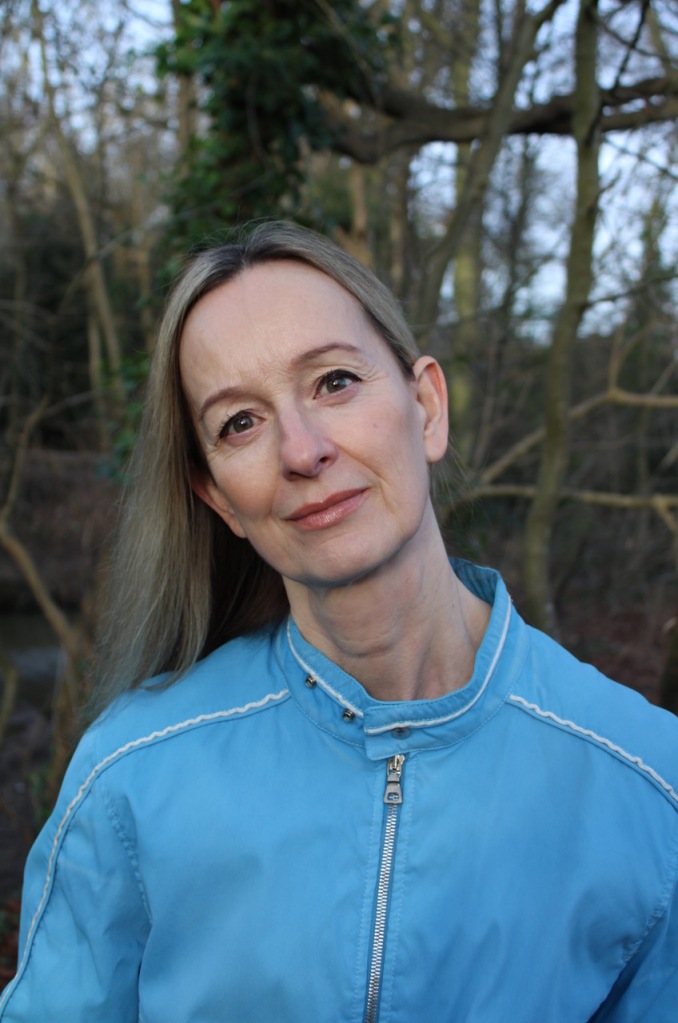
Welcome to a new interview in our series on writing the #MoreThanHuman, a set of interviews with poets and writers on how they approach writing about the environment. The more-than-human is a phrase that seeks to side-step traditional nature-culture dualisms, and draw attention to the unity of all life as a kind of shared commonwealth existing on a fragile planet. It also reminds us humans that there is more to life, that there is more world, than the human; it relocates us in relation to the mystery.
This week’s interview features Lisa Kelly, whose second collection, The House of the Interpreter (Carcanet), is a Poetry Book Society Summer Recommendation. Her first collection, A Map Towards Fluency (Carcanet), was shortlisted for the Michael Murphy Memorial Poetry Prize 2021. She has single-sided deafness and co-edited What Meets the Eye (Arachne Press).
IN THE GREEN CHAPEL

Please find a google word doc accessible version of this poem here.
As well as being translated by Simon Armitage, and adapted for the feature film, The Green Knight, the central investigation of the relationship between human and more-than-human’ in ‘Sir Gawain and the Green Knight’ seems increasingly relevant. Beyond the allusion in your title, how significant are the events or themes in the story to your poem?
I have not seen the film – it is now on my list! But thank you for your questions, and for the prompt to re-read Simon Armitage’s translation of ‘Sir Gawain and the Green Knight’. The Green Knight is more-than-human, with his ogre-like appearance – green from his bushy beard to his boots. However, his costume reveals his affinity with the natural world; his dress is embroidered with butterflies and birds, and he needs no armour but carries in one hand a sprig of holly and in the other an axe. It turns out that the Green Knight is less of a threat to the order of things than Sir Gawain who reveals he cannot keep his promises during his quest. At the end of the epic, Sir Gawain wears a green sash as a sign his honour is stained with sin. I find this interesting in the current political context when politicians fail to keep their promises to meet their environmental targets and reduce carbon emissions. The Green Chapel is where Sir Gawain must meet the Green Knight and when I wrote my poem I was not consciously thinking of this location, but my own feelings about walking in woods which is the closest I come to something approaching the spiritual. Reflection, however, can be sobering. The idea of ghosting is familiar in the modern sense of ignoring someone and severing all contact, especially via social media, but I am more interested in the idea of how we ‘ghost’ ourselves – ignore what is nagging us, refuse to confront our responsibilities, whether environmental or social. Sir Gawain knows he might literally lose his head during his venture, but the toppling in my poem is more associated with ego and how it can let us down. The green chapel is not invitingly green in the epic; it is only in the fourth section, or fifth, that we see it. The chapel is “a mound,/ a sort of bald knoll” and its walls are “matted with weeds and moss”. Sir Gawain is scathing:
‘Green church’ chunters the knight.
‘More like a devil’s lair
where at the nub of night
he dabbles in dark prayers.’
I enjoy this humorous reaction, but I think at this point Sir Gawain is an unreliable narrator. When I imagine a green chapel, it is a canopy of leaves in late spring on my regular walk around the Darlands Nature Reserve in north London and is far more welcoming. A beautiful green space can, however, make us feel melancholic when we think about how many similar spaces are under threat.
There are many aural references in the poem. As a poet with single-sided deafness, do you feel your relationship to sound affects how you navigate your writing?
My single-sided deafness is central to my poetics. I am always conscious of sound and silence. Having to listen harder than someone without hearing loss makes me hyper-sensitive to words and sound. I have chosen not to have a cochlear implant in my left ear – and instead, have focused on learning British Sign Language (BSL). However, I was not brought up with any access to BSL, Deaf culture or awareness of Deaf politics until much later in life. I was just told to get on with it and sit at the front of the class. Last year, I requested my medical records to see what more I could find out about my deafness. I was informed it was through contracting mumps but that is just speculation. Many records have been lost, but I received a photocopied letter from my GP surgery, sent by an Ear, Nose and Throat specialist whoreferred to my deaf ear as ‘a dead ear’ which I found upsetting. I hope that expression would not be used now. More awareness is needed within the medical establishment and wider society about deafness, but more needs to be done. I only speak for myself as there are so many ways deafness can affect people. Some deaf people might opt for hearing aids, some might choose cochlear implants, others are strongly rooted in Deaf culture and BSL, and some like me, learn BSL later in life. Whether you see deafness as a medical problem or a rich culture with its own language, affects your individual experience. When it comes to poetry, dealing with uncertainty offers interesting territory to explore, so yes, my relationship with sound, silence, and language – English and BSL – very much affects how I navigate my writing. I also believe that sound is not the preserve of the ears and that we ‘hear’ with our whole bodies. Escaping from noise is important to me as I find active listening for extended periods tiring and walking in green spaces offers a respite. The second stanza of my poem is sonically-driven. I love rain and watching rain hit leaves and how drops dance. We hear through ‘vibrations’ – there is a very good Ted Talk by the deaf percussionist Evelyn Glennie who explains how she ‘hears’ through such vibrations. In ‘How to listen to music with your whole body,’ she says, “When I see a tree move, I imagine that tree making a rustling sound…Whatever the eye sees, there’s always sound happening.”
In your recent exchange of letters with Paul Stephenson, on Wallace Stevens, you wrote, ‘we all, as poets and writers, are environmentalists today’ – in your opinion, is the role of poetry to ‘better hear each drop each echo each heartbeat’, or to register the foreboding ‘decay’ our footprints lead to (and from)?
Living, let alone writing, in the Anthropocene means everyone is shaped by environmentalism. How that manifests in poetry is very much an individual thing and a choice, but I would suggest that even a poem that does not appear directly concerned with nature or the environment will be working at some level against the background of climate change disaster. I would not like to assign a role to poetry; every poet finds their own path and paths can diverge. Allowing yourself to be directed and misdirected is where the interest lies for me when approaching a poem. If I thought I was doing the same thing every time and knew exactly what a poem should be doing, it would no doubt be as boring for the reader as it would be for me. Attention to the environment through our senses and the embodied experience of the environment is something I am more attracted to exploring as I feel it can avoid beating your reader over the head with your message on a banner in block-red capitals. However, poems that warn, rail at, or shine a light on human activities that are exacerbating environmental devastation have their place.
Is there more literature can accomplish as a form of activism in itself?
I feel putting pen to paper or fingertips to keyboard to write a poem is a form of activism, especially for poets who write without any certainty their poems will be published, find an audience and with little or no financial reward. Most successful activism is often achieved as a community. The biggest consumers of poetry are poets. When poets get behind something, then you can see real changes happening at a societal level, but it takes time and energy that are in short supply. I am wary of activism that is judgemental – often through ‘policing’ on social media. That is not activism; that is bullying. I appreciate what Modron is doing with its focus on the ecological crisis, and I know it must be a labour of love without funding. I hope that issues of Magma Poetry have encouraged activism – highlighting themes that are important, including the Deaf issue; the Climate Change issue; the Dwelling issue and the Obsidian issue. There is always more to do, but cuts to the arts are the biggest barrier to activism. Many poetry magazines have been forced to close because they are no longer financially viable with increasing production costs and the cost-of-living crisis eating into the affordability of subscriptions. It would be a terrible shame if the pool shrunk to those magazines funded by the state or universities; they risk becoming enclaves where activism is impossible because thought and approach eventually cements.
On the subject of eco-poetics, you praised writers who are able ‘to stand apart from (nature) and appreciate it without the human-centric permeating the poetry’. Was this ethos core in writing ‘In the Green Chapel’? Is it central to how you approach the more-than-human in your wider writing?
I break my own rules or ideals all the time! I think my poem ventures into the contested aesthetics of anthropomorphism, by investing birds with a power to see into the soul and judge human behaviour but I do feel a connection with birds as signs and emblems from ‘another’ world which is part of a personal environmental mythmaking. The animals in ‘Sir Gawain and the Green Knight’ are horribly hunted, with graphic descriptions of the chase and the kills of respectively deer, a wild boar, and a fox. I find this violence disturbing, but it was written in a different era and the relationship with the countryside and wild animals was more honest than it is in much of the western world with intensive factory farming on the one hand, and the celebration of images of cute, fluffy animals on the other. The subjugation of the natural world by humans or the romanticising of it are two very real strands of behaviour and poetry that can resist or examine this behaviour I find compelling. I have been reading Teaching Environmental Writing by Isabel Galleymore; a collection of essays on the topic and there are conflicting points of view about how poets should write about the environmental crisis, examining among other things ethical anthropomorphism; the tension between first-person narration and environmental writing and New Materialism which draws attention to vibrant matter. I appreciate “the unity of all life as a shared commonwealth” but humans are liable to let individualism rule and this dynamic, like all conflict, generates ideas worth exploring, inner reflection and unpredictable directions. The challenge is to address it with honesty, awareness, and freshness so that activism linked to environmental writing continues to be provocative and promote positive action that works towards a collective energy.
 Lisa Kelly