
‘Signing in Clay’ after Nina Thomas’ beautiful film Place Setting commissioned by Animate Projects and British Ceramics Biennial
The pottery wheel and my first pottery class inspiring connections between different worlds, single-sided deafness, BSL, learning, loss and memory. Thankful for the opportunity to be part of this wonderful project.
Signing In Clay
Fingers are feeling for a new language
in clay, the ball centred on the silver wheel
with its four concentric grooves, so it sticks.
What sticks? Instructions from my teacher:
Always keep a film of water between your hands
and the clay so hands glide. Don’t let it dry out.
Flow stops language from drying out –
I must practise sign language, practise handshapes,
just as I practise squeezing hands so the clay cones.
Hands rise. The clay cones into a peak under
pressure – more pressure, more speed, more risk.
Hope as the wheel spins, hope as the world spins.
As the wheel spins, I hope to make something live,
something rise that is both beautiful and useful.
My foot puts pressure on the pedal to increase speed.
Pressure for change, BSL is legally recognised.
It is a peak, but more mountains to be climbed,
and sometimes I feel lost in a valley, looking up.
I am lost in this work, looking down at the clay
metamorphose. My thumbs touch like the thorax
of a butterfly, hands are the butterfly wings.
Butterfly wings with strength of purpose –
they settle on the clay. The wheel spins slower.
I have practised eclosion for opening, for shaping.
My thumbs make an opening, a valley out of clay.
They bear down and water pools at the bottom.
Fingers find an altered element as the chrysalis softens.
This is elementary for my teacher. I am in my element
as a beginner, but not part of the potter’s world.
Sat at another wheel, in another world, a virtuoso.
A virtuoso’s hands communicate with the clay
in silence – they shape a vase that might hold
purple buddleia, butterfly bush, a sign of rebirth.
Rebirth speaks to old lives. The clay is lifeless
before it is shaped by hands. I think of my deaf ear
described by my doctor as a dead ear – lifeless.
My deaf ear leads me to a living world of signs
as my hands work the clay on this turning wheel.
It is a rebirth – my arms are braced but not stiff.
I think of my Danish mother, my mother tongue dead,
never learned. I think of my deaf ear that led me to clay,
a potter’s wheel, to sit purposefully with my teacher.
My teacher is sitting on my right side, my hearing ear,
giving instructions, interpreted by my hands into
this shaped language, caught between two wheels.
We are caught between two worlds, two wheels –
her wheel and mine. They look the same, but each
produces something unique to be fired and glazed.
Sometimes, I forget how to use my hands, glaze over
at being told how to handle this strange element
as the wheel spins in an anticlockwise movement.
The wheel spinning at varying speeds is not
predictable. The wet sponge smooths mistakes –
unwanted ridges, fingermarks, and rough edges.
With a wooden knife, I clear away unwanted clay.
The wire cutter slices under the base so the pot
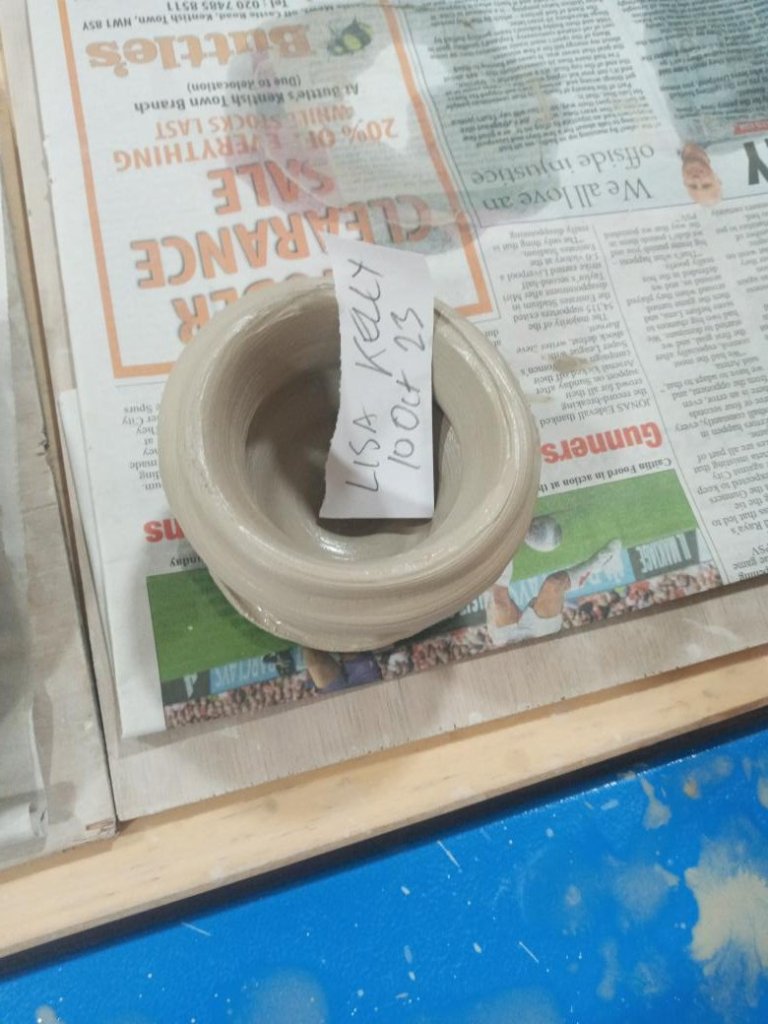
can slide off the wetted wheel to dry on old newspaper.
Old newspaper, language of yesterday. In three weeks,
I’ll fetch the pot. Let what is fired not crack,
let what is painted not flake. Let the pot look like a pot.
My hope is the pot will look like lessons learned,
that it can be filled and refilled, and offered to all
who take it with their hands, put it to their mouths.
 Lisa Kelly